





BOE has established a normalized water risk monitoring and response mechanism. The Group introduced the water risk assessment tool developed by the World Resources Institute (WRI) to systematically evaluate the water stress levels and potential risks of 18 display business operational bases. Display factory water consumption accounts for 93.94% of the Group's total water usage.
Based on the assessment results, the Group comprehensively considered each factory's water usage scale, structural distribution, and process characteristics to develop differentiated risk response plans. Key measures include strict water intake control, water-saving process upgrades, and water resource recycling, thereby enhancing operational resilience under water-scarce conditions.
This year's water risk identification and response assessment results are as follows:
| Risk Level | Number of Bases |
Proportion | Locations |
|---|---|---|---|
| Extremely High (>80%) |
4 | 22% | Beijing, Ordos, Qingdao, Mianyang |
| High (80-40%) |
8 | 44% | Suzhou, Chengdu, Hefei |
| Medium-High (40-20%) |
1 | 6% | Fuzhou |
| Medium-High (20%) |
5 | 28% | Chongqing, Wuhan, Nanjing |
| Category | Extreme Risk | High Risk | Key Measures |
|---|---|---|---|
| Wastewater Recycling |
4 | 5 | In Hefei and Chengdu factories with high water risk, implemented pure water system wastewater
recycling
and quality-based water supply renovation projects, including RO concentrate water recovery, backwash
regeneration water recycling, and scrubber and cooling tower optimized water supply. In 2025, cumulative
water savings reached 1.96 million m³, wastewater reduction of 750,000 m³, carbon emission reduction
of
955 tons, and cost savings of RMB 6.12 million. In Beijing, Ordos, Qingdao, and Mianyang factories with extremely high water risk, implemented advanced reuse renovation projects for cleaning drainage, filtered water, and cooling tower drainage recovery. In 2025, cumulative water savings reached 278,300 m³, effectively improving water recycling efficiency. |
| Water-Saving Technology Upgrades |
0 | 3 | In 2025, the Group planned and implemented a total of 47 water-saving projects, achieving cumulative water savings of 5.37 million m³ for the year. Among these, display device factories planned and implemented 43 water-saving projects with an investment of RMB 48.89 million, achieving annual water savings of 5.24 million m³. For example, high-risk factories in Chengdu and Hefei focused on cooling tower system optimization, implementing renovation projects such as precise make-up water control and packing replacement, achieving annual cumulative water savings of 1.17 million m³. |
| Alternative Water Sources |
1 | 0 | In 2025, the Group continued to deepen its water management approach of conservation first and recycling. Through technology upgrades and process optimization, the proportion of recycled water in the total water usage structure was significantly increased. Recycled water usage reached 5.11 million m³, accounting for approximately 5.95% of the Group's total water consumption, effectively reducing dependence on fresh water sources. For example, the Beijing factory replaced tap water with recycled water for ultrapure water preparation, achieving 100% use of recycled water for production, using over 20,000 tons of recycled water daily, saving approximately 3.3 million tons annually. The Ordos factory used wastewater treatment effluent as raw water to replace municipal water, recycling treated discharge water and mixing it with externally sourced recycled water for production, with annual recycled water usage of approximately 509,000 m³. |
| Water Pollution Prevention |
0 | 2 | Hefei, Chengdu, and Chongqing factories conducted innovative projects including phosphorus-containing and color film wastewater recycling, organic wastewater partial recycling and reuse, and acid-base wastewater recovery renovation projects. In 2025, cumulative water savings reached 1.43 million m³. |
| Water-Saving Awareness Cultivation |
6 | 8 | BOE actively conducted water conservation awareness and training activities to strengthen employees'
water-saving consciousness. In 2025, a total of 24 water-saving training and awareness events were
organized, encouraging employees to submit innovative water-saving proposals and fostering a positive
culture of "everyone focuses on water conservation, everyone participates in water conservation." The Chengdu factory established an energy conservation incentive program, guiding all employees to actively participate in water conservation across all processes. In 2025, 20 employee water-saving proposals were identified and received, including cooling tower overflow pipe modifications. 16 proposals were effectively implemented, saving a total of 71,124.5 m³ of water. |

BOE formulated the Group Energy and Environmental Management Policy, systematically integrating energy management requirements into the entire process of planning, construction, production, and operation. The Company prioritizes continuous improvement of energy utilization efficiency, reduction of energy consumption and carbon emissions, and prevention of energy risks to ensure compliant and low-carbon operations.
Amid the opportunities and challenges presented by green and sustainable development, the Company strives to build a mutually beneficial model with customers, align its development priorities with a green development roadmap to strengthen clean technology innovation.
At the strategic level, clean technology development has become a core business focus and a key priority for the Company’s future growth. Major clean technology areas include perovskite technology, net-zero carbon integrated energy services, low-energy-consumption product and technology, and smart chilled water system, which will directly contribute to green energy development and a low-carbon society.
At the management level, in June 2026, the Company elevated the management of environmental issues, including clean technology, to the Board level. The Board directly oversees the development and implementation of BOE’s sustainability strategy.
At the technology level, the Company invested RMB 13,983.06 million in R&D in 2025, accounting for 6.83% of revenue. Its R&D activities cover areas including perovskite technology, energy technologies, low-energy-consumption product and technology, and smart chilled water system. For specific clean technology areas, such as perovskite photovoltaics, Building-Integrated Photovoltaics (BIPV), smart energy management, and virtual power plant technologies, the Company has established dedicated R&D teams to accelerate technological development and innovation.
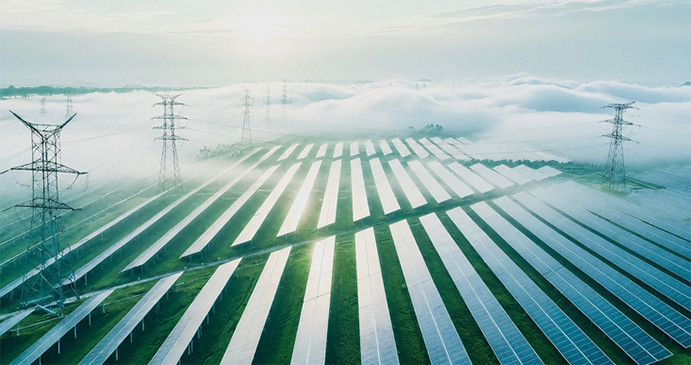
BOE conducts in-depth research into perovskite technology, promotes diverse application scenarios, contributes to the development of new quality productive forces, and drives transformation in the photovoltaic industry. Over the next decade, the Company will continue to advance innovation in perovskite materials and application scenarios, accelerating the green transformation of the photovoltaic industry and injecting strong momentum into new quality productive forces.
In 2025, BOE completed the full process chain from glovebox systems to pilot experimental lines and pilot production lines, achieving major breakthroughs in scaling up from small-area laboratory research to large-area industrialization. According to authoritative third-party laboratory tests, BOE’s small-area perovskite devices achieved a maximum stabilized efficiency of 27.94%. The pilot production line 2.88 m2 rigid modules achieved a power output of 579W, with a full-area efficiency of 20.11%, ranking first in the industry for large-area single-junction device efficiency. BOE’s flexible modules also set two world records, with a 21.39% efficiency on the experimental line and a 16.6% efficiency and 433W power output on the pilot production line. These achievements demonstrate that BOE’s perovskite photovoltaic module efficiency has reached a leading level in the industry.
In 2025, Hefei BOE Solar Technology Co., Ltd. accelerated the demonstration and application of perovskite photovoltaic technology. At the BOE Gen 10.5 TFT-LCD production line campus in Hefei, the Company established the “Zero-Carbon Cabin,” a comprehensive perovskite BIPV application project. The project received one of the first batches of Photovoltaic Building Evaluation Certification in China and was also awarded the “Photovoltaic & Energy Storage Applications Award” by the Asian Photovoltaic Industry Association.
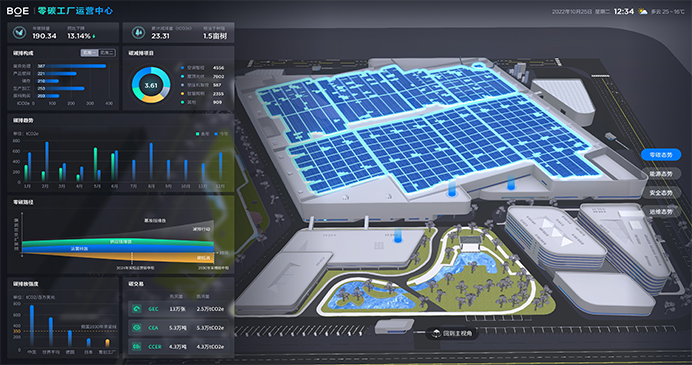
Building on the efforts to strengthen energy management across its own production and operations, BOE extends its energy management capabilities to typical energy-consuming scenarios, including factories, industrial parks, and commercial complexes. The Company is progressively developing multi-scenario net-zero carbon integrated energy service capabilities to drive the broader green and low-carbon transformation.
During the 15th Five-Year Plan period, the Company will continue to deepen its core businesses, including integrated wind-solar-energy storage-charging solutions, energy management and energy-saving retrofits, and net-zero carbon scenario services. It will also actively explore innovative application scenarios such as net-zero carbon industrial parks, computing-electricity coordination, and direct green power connection, while accelerating new businesses development such as EV charging stations, Vehicle-to-Grid (V2G), and virtual power plants. These services will support stakeholders across different sectors, including new energy vehicles, power and energy sector, and public institutions, advancing energy conservation and carbon reduction.
The Company will further strengthen innovation in clean technology, focusing on end-to-end scenarios across the “source–grid–load–storage–carbon–charging” value chain. It will improve technical solution capabilities, enhance the technology foundation of the Net-zero Carbon Intelligent Energy Management System (BES), and advance the digital and intelligent capabilities of its professional platforms, dedicated to providing customers with integrated energy and carbon management capabilities.
BOE has been deeply engaged in net-zero carbon integrated energy services for many years. Leveraging its independently developed BES Intelligent Energy Management System, the Company has established a collaborative business architecture, with AI technology as its core engine, net-zero carbon scenarios as practical applications, and multimedia charging stations as interactive terminals. Through an implementable net-zero carbon pathway of “decarbonization at source – carbon reduction during process – negative carbon at the end – intelligent carbon management,” BOE continues to provide customers with one-stop net-zero carbon solutions. With complementary strengths of digital technologies and energy systems, the Company drives the green transformation of industries and helps customers achieve their low-carbon targets.
BOE deeply integrates circular economy principles into its operational practices and proposed an industry-leading “1 Major Cycle + 7 Minor Cycles” green development system, embedding circular economy principles throughout its operations. Through optimized management mechanisms, internal circulation of key waste liquids, and innovative packaging recycling models, the Company continuously improves resource efficiency, reduces reliance on primary resources, and drives the green and low-carbon transition of its operations.


BOE Technology Group Co.
Beijing BOE Optoelectronics Technology...
Beijing BOE Display Technology...
BOE Construction Project Completion...
The Advanced Path to Carbon Neutrality:BOE Display's Low carbon Strategy...
The Path to Carbon Neutrality: BOE Display's Low- carbon Strategy Report
BOE Green Development White Paper